Dolphin Life History
Dolphin, the Perfect Gamefish?
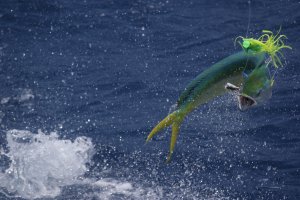
In today's world of bio-genetically engineered food products, science strives to produce perfect plants and animals. These altered organisms typically feature higher growth rates, higher reproductive capacity and improved food quality. If science applied these qualities to a fish, they would attempt to recreate the dolphin fish, Coryphaena hippurus.
The common dolphin, frequently called mahi mahi or dorado, is likely the perfect game fish. Ranging worldwide in warm temperate and tropical oceans, this species is recognized as a premier game and food fish wherever it is found. The dolphin is revered among anglers for its aggressive strikes, long, fast runs, stunning aerial acrobatics and its vibrant, neon colors. Historically harvested almost wholly by recreational fishermen around the world, only in recent decades did the fish catch the attention of commercial anglers. Today the species is a shared stock between recreational and commercial interests, both vying for their share of this true seafood delicacy.
Ranging from Massachusetts to the Florida Straits, throughout the Gulf of Mexico and the Caribbean down to Brazil, dolphin are commonly found in the warm oceanic waters of the western North Atlantic where surface temperatures exceed 70F. Pelagic by nature, they live their life in the uppermost portion of the water column but have recently been found to dive to depths beyond 800 feet presumably to feed. These fish are commonly found off the east coast of the U.S. in schools aggregated under large mats of Sargassum weed that drift in from the Sargasso Sea. School size decreases as the fish grows. Later, large males, commonly called bulls, take on a solitary, nomadic life. On the East Coast from North Carolina southward, dolphin are present virtually year round in the warm waters of the Gulf Stream, but are at peak abundance April through July. As shallower Continental Shelf waters warm in the summer, the fish move closer to shore, occasionally being found within ten miles of the coast off the Carolina's and even in the surf off southeast Florida.
The species matures at an early age, estimated as early as 3 months. Dolphin are known to be sexually mature as small as 14 inches in fork length, with all fish reaching sexually maturity by the time they are 24 inches in fork length. The presence of very young dolphin almost year-round in the Florida Current, coupled with almost continuous spawning observed in some captive fish, may indicate these fish spawn continuously throughout their life. A Florida study calculated that a female 39 inches in fork length produces roughly 555,000 eggs per spawn.
With such rapid growth, it is only natural that dolphin possess a voracious appetite and are aggressive predators. They are opportunistic feeders, eating whatever is abundant at the time, even each other. Off North Carolina squid, crabs, small jacks and small triggerfish, which are the most abundant members of the Sargasso weed community, comprise the bulk of their diet. However, off Barbados, flying fish and its cousin the flying gurnard are more prevalent in the area and make up the bulk of dolphin's diets, with squid and small triggerfish playing a smaller role. Dolphin held in captivity have consumed over 20 percent of their body weight in food per day.
Dolphin may very likely be the fastest growing wild fish known to man. This species has been reported to grow as fast as 1.3 to 2.7 inches in length per week. Growths of 0.5 to one inch per week is more typical of fish in the wild. Studies have shown dolphin are capable of reaching a body length of four feet and a weight of 40 pounds in less than 12 months. Males were found to grow at a faster rate than females, weigh as much as 20 percent more per given length and reach a larger size at equal ages. Females seldom exceed 40 pounds while males routinely reach 60 pounds with the current world record being an 88-pound bull caught in 1998 in the Bahamas. Dolphin is one of the few species of fish where the sexes can be identified by external features. Males have a pronounced blunt head shape while the females are gracefully rounded.
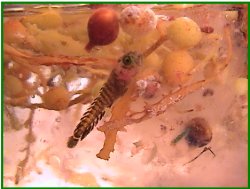
Dolphin are known to spawn along the entire U.S. East Coast as evidenced by the collection of early juvenile fish and adult fish in spawning condition in the offshore waters from spring through fall. They are described as batch spawners, reproducing multiple times during the year. Spawning takes place in the warm, open waters of the Gulf Stream where the females release their eggs into the water for the males to fertilize. Young dolphin possess an innate instinct to associate with Sargassum and other objects floating in the ocean for protection from predators.
Any animal that lives life in this "fast lane" is bound to have a down side. Dolphin serves as an important forage species for most of the ocean's apex predators such as marlins, sharks and cetaceans. Research indicates that the annual production of juvenile dolphin suffers a total annual mortality level of 98 to 99.7 percent. This would translate into only 0.3 to 2.0 percent of all dolphin fry produced in a given year to survive a full 12 months. Aging studies conducted on fish harvested in North Carolina, South Florida and Barbados in the Southern Caribbean found that fish less than 1 year of age made up 80, 74 and 100 percent respectively of all fish landed by fishermen. These are very high percentages considering that these are very biased fisheries, generally selecting older, larger fish. Two year-old fish are exceptionally old for the species and have been shown to make up less than 3 percent of the catch. The oldest individual reported was only four years old. This means that dolphinfish are virtually an annual crop.
The species is considered highly migratory and is known to travel over 800 miles in 9 days (Islamorada, FL to Oregon Inlet, NC) and can move more than 130 miles from one day to the next. Recoveries of fish tagged off the South Carolina coast shows that when leaving, they move north to North Carolina venturing even as far north as Long Island, NY. Tag recoveries in this study have linked U.S. East Coast fish with Cuba, Dominican Republic, Puerto Rico, Antigua, St. Kitts, Venezuela, and Mexico's Yucatan. Other tag recoveries have documented fish traveling from Puerto Rico and the eastern Bahamas to the U.S. Atlantic Coast and from the Gulf of Mexico into the Atlantic. Two attempts to use molecular genetics to identify the various stocks of dolphin present in the western North Atlantic resulted in contradictory findings in showing differences or lack there of among fish from the Southern Caribbean, Gulf of Mexico, Bahamas or U.S. east coast.
The Marine Resources Division of the SC Department of Natural Resources initiated a four-year study in 2002 to address questions about the geographic range of the U.S. east coast dolphin stock. The research utilized uniquely numbered streamer tags to mark individual fish in order to track their movements, migrations and dispersal patterns. The study relied upon volunteer anglers from New York to Key West and into the Bahamas to tag dolphin along the full length of their east coast range. Since 2006 this study has been carried forward by Cooperative Science Services, LLC of Charleston, SC.
Through the recapture of these fish, science has begun to map movements of individual fish and the species as a whole. Because fish can be individualistic in behavior, it will require the recapture of many fish over many years to establish patterns of distribution or migrations. Tag recovery rates for this highly migratory oceanic fish is only 2 to 3 percent. The recapture of tagged dolphin is complicated by their extremely high annual mortality, highly migratory nature and overall short life expectancy. This means that each tag recovery is extremely valuable and very important to the success of the program.
By
Donald L. Hammond
Marine Fisheries Biologist
Director
Dolphinfish Research Program
Cooperative Science Services, LLC