Growth In Dolphin
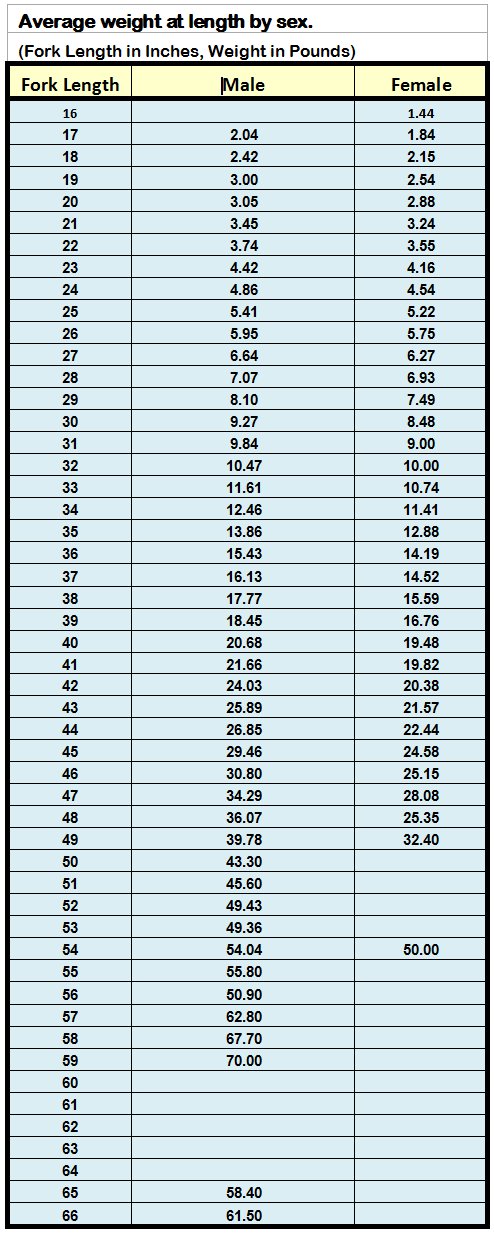
One of the immediate tools that come from gathering length, weight and sex data from fish is the generation of a table showing the average weight at length. To arrive at an accurate representation for fish throughout their size range requires processing large numbers of individuals at all sizes. Plus, if the fish exhibits large variations in their weight at a given length, then larger sample sizes are required to ensure accuracy. On top of this, if the sexes exhibit difference in their weight at length, then the fish must be analyzed by each sex doubling the categories as well as the number of specimens needed for proper analysis.
For dolphinfish you are looking at about 51 categories if you are breaking them down into one-inch groups from 16 to 66 inches. Male dolphin clearly weigh more at a given length, so now the number of categories for analysis has basically doubled to 90 groups. (Female do not grow as big as males.) Then as we collect data on dolphin by sex we see large-scale variation in their weight at every length. This is why researchers can never have enough data.
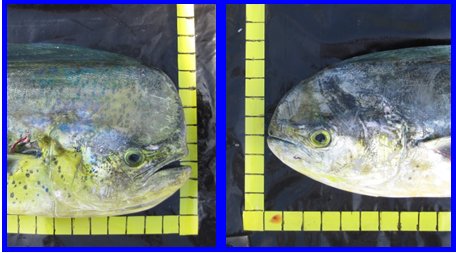
Sexes can be distinguished by the shape of the fish's head. Above, a 36-inch male (left) is compared to a 36-inch female dolphin. The male's prominent cranial crest gives its head a blunt appearance and serves as an external identifier of its sex.
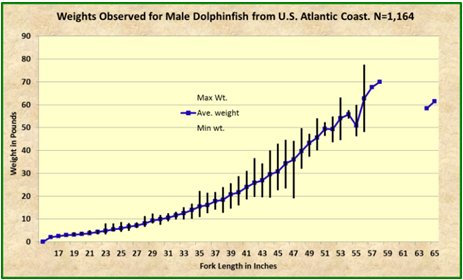
The design of the dolphin's body, long and deep, allows for wide fluctuations in the fish's weight at any length. Thanks to the dolphin's high metabolic rate and its skeleton's long broad frame, the fish can build up large amounts of muscle tissue during times of bountiful food. This is critical to sustaining the fish during times when food is in short supply. Abundance of dolphin's prey species fluctuate year to year and area to area which results in changes in the dolphin's weight at length. A graph of the maximum, minimum and average body weight for male dolphin demonstrates the wide range of weights observed at each length. (See figure below.) At 25 inches FL fish range in weight from 4.5 to 8 pounds. When the fish reaches 36 inches FL, the variation jumps to 10.8 to 22 pounds, and at the length of 48 inches FL the range widens to 19 to 44 pounds. Such wide range in weight for a given length is why the data from 1,164 males and 1,210 females is needed to begin to construct an accurate representation of their weight.
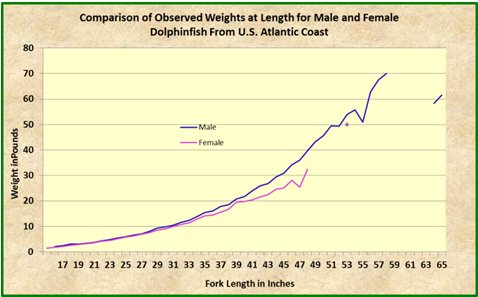
In a graph comparing the average weight at length for the two sexes, a visual difference begins to emerge when they are around 28 to 29 inches. (See figure below.) However, the difference begins even earlier. When dolphin are 25 inches or less, males can weigh 10 to 15 percent more on average than females. At the upper end of their size range for female dolphin, 40 to 48 inches FL, males weigh an average 16 percent heavier than females of the same length but can exceed females by as much as 29 percent.
Because of variations in food availability from year to year, which translates into heavier fish at a given length in some years, the data used in this weight-at-length table were collected over a 14-year period. This includes data from the South Carolina Department of Natural Resources as well as data provided by Florida Atlantic University, Boca Raton, Florida, and Palm Beach Atlantic University, West Palm Beach, Florida. All of the fish used to compile this table were collected from Key West, Florida, to Oregon Inlet, North Carolina, giving a broad sample of fish from the entire South Atlantic Bight.