Dolphin Research Program
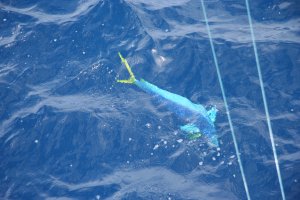
When you combine the dolphinfish's aggressive feeding behavior, brilliant coloration, abundance and quality as a food-fish, it is easy to understand why it is considered one of the world's foremost game fish. In its annual surveys of subscribers, SaltWater Sportsman magazine consistently found dolphin to be the most popular offshore gamefish along the United States' Atlantic and Gulf coasts. Prior to the mid-1990s, dolphin were almost wholly harvested by recreational anglers and were the primary creel component sustaining an important offshore sports fishery.
When commercial fishermen began targeting dolphin, major concerns arose among fishermen along the entire Gulf and Atlantic coasts. Anglers voiced fears that without a management plan governing harvest, dolphin stocks could be overfished to the point of a major decline. In 1998, the South Atlantic Fisheries Management Council (SAFMC) was directed to work with the Gulf and Caribbean Councils to develop a joint management plan for dolphin and wahoo. However, because of differences in the regional fisheries, little progress was made on a common plan. In 2002, the U.S. Department of Commerce approved development of a separate management plan by the SAFMC for the Atlantic coast, which resulted in the implementation of a management plan in 2004 for the Atlantic fisheries.
In developing the management plan for dolphin, managers found that there were many important facets of the dolphin's life history that were unknown. For example, little is known about the movements and migrations of the fish along the U.S.'s Atlantic and Gulf Coasts. The geographic range of the fish found in U.S. waters is also very important in developing an effective management plan. Managers must know if the stocks fished in U.S. waters are shared with other countries. Shared stocks occur when fish migrate into other nations' waters, such as the Bahamas, or simply when they range beyond the 200-mile Exclusive Economic Zone (EEZ) controlled by the U.S.
A study conducted in 1991to track dolphin movements along the U.S. East Coast resulted in only 60 fish tagged and four tag recoveries, producing little viable information. Two early attempts to use genetic material analysis to determine if multiple stocks existed in the Western North Atlantic yielded contradicting results as to whether differences did exist between fish found in other areas of the Northern Atlantic and those found off the U.S. East Coast.
Entering the new millennium, science still had little concrete information documenting the movements, occurrence and dispersal patterns for dolphinfish present off the US east coast. This data gap, coupled with strong vocal support for research on dolphinfish by constituent offshore fishermen, prompted the Marine Resources Division of the South Carolina Department of Natural Resources (SCDNR) to initiate a study on dolphin in 2002 under the direction of Don Hammond.
 SC Department of Natural Resources Begins Study
The SC dolphin tagging study initiated by the SCDNR was designed to address the travels of dolphin along U.S. shores in hope of beginning to define the movements and migrations. The study was highly successful in its four years of operation with more than 4,900 dolphin tagged and 116 tagged fish reported recaptured.
Cooperative Science Services, LLC Continues Dolphinfish Research
The amazing information the SCDNR study generated inspired anglers to request that the research be continued. The Cooperative Science Services, LLC, a private fisheries research consulting company, was founded by Don Hammond to continue the dolphin research project following his retirement from the Department. Conservation-minded fishermen were willing to donate the necessary funding to allow the study to start up and continue as a private research program since 2006. This important research is financed solely by private donations.
The Hilton Head Reef Foundation, under the leadership of David Harter, recognized the important need for research on dolphishfish because of their importance to the offshore recreational fishery along the U.S. Atlantic Coast. The Reef Foundation's Board agreed to work with Cooperative Science Services, LLC to raise private funding in support of the Dolphinfish Research Program. Working through the Community Foundation of the Lowcountry, the Reef Foundation plays a major role in securing private donations by providing tax deductible status for all donations received by the Foundation because of their 501 (c) (3) status.
The research effort has three primary components. The first is the Mark and Recapture Study. This study relies of private fishermen to volunteer to tag and release their small and unwanted fish for science. Fishermen throughout the Caribbean, Gulf of Mexico and western north Atlantic are provided free tagging kits to mark their unwanted fish. More than 600 boats and 1,800 anglers have tagged 16,000 dolphin for science with more than 450 tags reported recovered. The second segment is the Satellite Tag Tracking Study. This study utilizes the latest technology to study underwater behavior and long distance movements of dolphinfish through the use of pop-off satellite archival tags. The study has deployed a total of 18 of these miniature computers on fish in the Caribbean Sea, western central Atlantic and off the U.S. Atlantic coast. While these unit are very expensive, costing $4,000 each plus the cost for the satellite time to recover data, they are the most cost effect way the learn about the hidden life of dolphin. The instruments have reveal that dolphin will dive to depths beyond 800 feet and engage in deep diving during the day as well as the night. The third segment is the Life History Study. In this phase the DRP seeks to work with colleges and universities to encourage research on dolphinfish. So far the program has worked with graduate students at Duke University, North Carolina State University, University of Puerto Rico, Texas A & M University and the University of Texas. This study also seek the help of anglers, fishing clubs and tournaments to assist in collecting biological data and sample on the fish they catch for use in life history and fishery monitoring studies.
Incentive awards are offered fishermen participating in the Mark and Recapture Study. Each angler who provides five or more fish in a calendar year for tagging, captains whose boat crew tags ten or more fish in a year and anyone reporting the recovery of a tagged fish, will receive a free DRP project T shirt. At the end of the year a Star Hand Crafted standup rod with a TLD 30 or 50 reel is presented to the boats tagging the most fish in each of four divisions, plus the top overall charter boat and top overall private boat. The divisions are the Mid-Atlantic Bight, South Atlantic Bight, Gulf of Mexico and the Tropics (Caribbean and Bahamas). Costa Del Mar provides a special gift pack valued at more than $400 to the boats finishing second in the four regional categories. These awards are made possible by the generosity of Haddrell's Point Tackle, Charleston and Mt. Pleasant, South Carolina, Star Rods a division of BRS Sea Striker of Morehead City, North Carolina, and Costa Del Mar of Daytona Beach, Florida.
This study has shown many amazing facets about U.S. East Coast dolphin that were never even considered before. The have been shown capable of traveling 130 miles in a day, traveling the full U.S. East Coast in less than two months, traveling to the Eastern Atlantic off the Azores Islands, and throughout the Caribbean Sea. The DRP produces a monthly electronic newsletter to inform fishermen and interested members of the public of the latest findings of the research. To learn more about this most perfect game fish, how to become a part of the research, and about the amazing discoveries by the program visit the Dolphinfish Research Program's Web site at www.dolphintagging.com.